Journey to the West (2009) 西游记
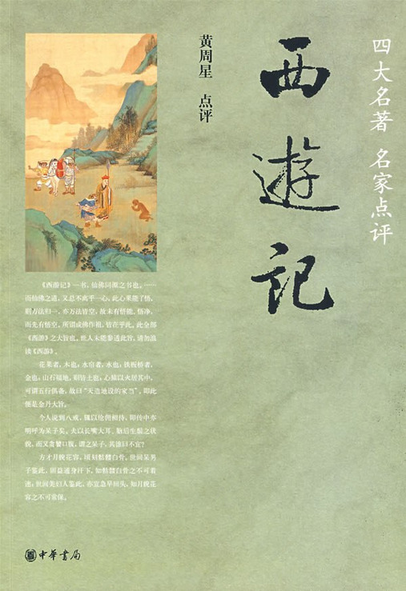
Author: Wu Cheng'en
Commentary: Huang Zhouxing
Publisher: Zhonghua Book Company
Format: Paperback
Date: June 2009
Pages: 488
Book Series: Expert Commentary on the Four Great Classical Novels
Number of issues: 4
ISBN: 9787101066494
Language: Chinese
Adaptation: Retelling
Summary:
Journey to the West is hailed as the pinnacle of Chinese supernatural fiction. It chronicles the story of Sun Wukong (the Monkey King), Zhu Bajie (Pigsy), and Sha Wujing (Sandy) as they escort the monk Tang Sanzang on a pilgrimage to the Western Heaven to retrieve sacred scriptures; after overcoming eighty-one tribulations, they successfully obtain the true sutras and attain spiritual enlightenment. The novel is based on the historical journey of the monk Xuanzang, who traveled to the West during the Zhenguan era of the Tang Dynasty. Xuanzang’s seventeen-year odyssey took him through more than fifty countries in the Western Regions, and he returned to the capital, Chang'an, with 657 Buddhist scriptures. This unprecedented feat in the history of Buddhism—along with the myriad hardships and fantastical encounters Xuanzang experienced—became a rich source of inspiration for folk literature and art. During the Song and Yuan dynasties, the story of the pilgrimage was frequently performed in operas, recounted by storytellers, and depicted in temple murals, eventually serving as source material for later writers of fiction.
The renowned scholar Huang Zhouxing collaborated with the bookseller Wang Xiangxu to refine and revise the hundred-chapter version of Journey to the West, resulting in the publication of the Xiyou Zhengdao Shu (Journey to the West: Verifying the Way)—an edition that represents the most mature and widely circulated version of the novel.
Huang Zhouxing’s commentary forms a cohesive system of thought, aiming to elucidate the theory that Buddhism and Taoism share a common origin—and, by extension, that Confucianism, Buddhism, and Taoism all stem from the same source. The title Xiyou Zhengdao Shu ("Verifying the Way") reflects the further exposition and elaboration of this theory. Rooted in the doctrines of the Quanzhen (Complete Perfection) school of Taoism, the work also draws upon Buddhist Chan (Zen) and Confucian Neo-Confucianism, embodying the philosophy of the shared origins of the Three Teachings. The pre-chapter commentaries, written under the pseudonym "Dan Yizi," offer Huang’s systematic explanation of the theory that immortals and Buddhas share a common origin. His insights are brilliant and unique; even a few brief words can leave a profound impression, eliciting admiration for his deep understanding. This edition promises to greatly enhance the reader's experience. Simplified Chinese, horizontal layout, two-color printing
