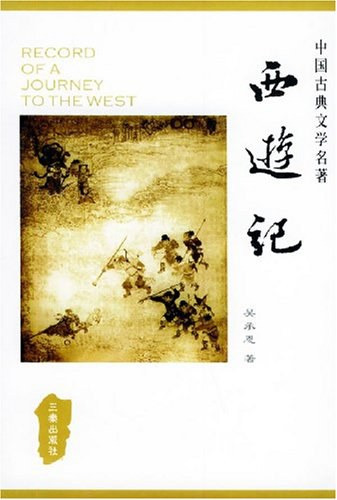
Author: Wu Cheng'en
Publisher: Sanqin Publishing House
Format: Paperback
Genre: Fantasy
Date: January 1994
Pages: 933
ISBN: 9787805468402
Language: Chinese
Adaptation: Retelling
Summary:
Journey to the West primarily recounts the story of Sun Wukong (the Monkey King) escorting the monk Tang Seng (Tripitaka) on a pilgrimage to the West to obtain Buddhist scriptures, a journey marked by eighty-one tribulations. The pilgrimage itself is a historical fact. Approximately 1,300 years ago—in the first year of the Zhenguan era of Emperor Taizong of the Tang Dynasty (627 AD)—a 25-year-old monk named Xuanzang departed from the capital, Chang'an, and traveled alone to India (then known as Tianzhu) to study. His arduous journey took him through Central Asia, Afghanistan, and Pakistan before he finally reached India. He spent over two years there, earning great acclaim for his role as a lead speaker at a major Buddhist scholastic debate. In the nineteenth year of the Zhenguan era (645 AD), Xuanzang returned to Chang'an, bringing back 657 Buddhist scriptures. His nineteen-year expedition, covering tens of thousands of miles, was a legendary odyssey that caused a sensation at the time. Later, Xuanzang provided an oral account of his travels. As for Zhu Bajie (Pigsy), his intentions are fundamentally good; he is not a character meant to be condemned, which is why people do not despise him—on the contrary, they find him quite authentic and endearing. The character of Tang Seng is also well-drawn, though he pales in comparison to Sun Wukong and Zhu Bajie. Sha Seng (Sandy), meanwhile, lacks a distinct personality—a notable shortcoming in Journey to the West. Nevertheless, the novel achieves remarkable artistic success. Earlier works—such as the Poetic Tales of Tripitaka of the Great Tang Fetching Scriptures (from the Song Dynasty), the yuanben (short theatrical sketches) Tripitaka and The Peach Banquet (from the Jin Dynasty), and Yuan-dynasty zaju (operatic dramas) like Wu Changling’s Tripitaka Fetches Scriptures from the West and the anonymous Erlang Shen Chains the Great Sage—all laid the foundation for Journey to the West. It was upon this bedrock of folklore, huaben (vernacular stories), and traditional drama that Wu Cheng'en, through painstaking creative effort, crafted this great literary masterpiece—a source of immense pride for the Chinese nation.
Wu Cheng'en, whose courtesy name was Ruzhong and who went by the pseudonym "Sheyang Shanren" (Hermit of Sheyang Mountain), was a native of Shanyang in Huai'an Prefecture (present-day Huai'an City, Jiangsu Province). Wu Cheng'en was born sometime between the 13th year of the Hongzhi reign and the beginning of the Zhengde reign of the Ming Dynasty (c. 1500–1510) and died around the 10th year of the Wanli reign (1582). Both his great-grandfather and grandfather were scholars who served as instructors and preceptors in the county-level Confucian schools. By the time of his father, Wu Rui, the family had fallen into poverty; Wu Rui married into the Xu family—a practice known as zhuizhui (matrilocal marriage)—and took up the Xu family’s trade, becoming a small-scale merchant. Nevertheless, the Wu family’s scholarly tradition endured. It is said that although Wu Rui was a merchant, he was a man of upright character who loved reading and discussing current affairs—an influence that left a significant mark on Wu Cheng'en. Highly intelligent from a young age, Wu Cheng'en entered school early and gained a local reputation for his precocious talent. According to Volume 16 of the Huai'an Prefecture Gazetteer (compiled during the Tianqi reign), Wu Cheng'en was "quick-witted and exceptionally bright; he read extensively and could compose poetry and prose with effortless, immediate fluency." However, his adult life was marked by repeated setbacks in the imperial examination system—the standard path to official advancement. It was not until his forties that he finally attained the status of a suigongsheng (a tribute student selected for the imperial academy), and in his fifties, he served as an assistant magistrate (xiancheng) in Changxing County, Zhejiang. Later, he held a position as an jishan (an official in charge of education and moral guidance) in the household of the Prince of Jing—a largely nominal post of similar rank to an assistant magistrate. It is believed that Wu Cheng'en wrote Journey to the West during his middle or later years, though the exact timing remains uncertain. In addition to Journey to the West, he authored the long poem Song of the Painting: Erlang Searches the Mountains (Erlang Soushan Tu Ge) and the collection Tales of the Yu Tripod (Yu Ding Zhi). A four-volume collection of his surviving writings, titled Collected Drafts of Master Sheyang (Sheyang Xiansheng Cun Gao)—comprising one volume of poetry and three volumes of prose—was compiled by Qiu Du after Wu Cheng'en’s death.
