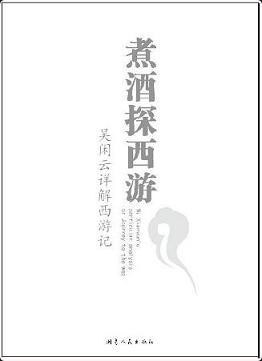
Author: Wu Xianyun
Publisher: Hunan People’s Publishing House
Genre: Non Fiction
Date: August 2009
Pages: 265
ISBN: 9787543858824
Language: Chinese
Also known as: Unsolved Mysteries of *Journey to the West* / 西游记未解之谜
Adaptation: Meta
Summary:
The story of Journey to the West is a household name. On the surface, it recounts the pilgrimage of the monk Tang Seng and his three disciples, who brave countless perils and overcome immense obstacles to finally attain enlightenment.
However, a closer look at the text reveals a multitude of logical inconsistencies and contradictions—points that simply cannot be explained by conventional reason.
For instance:
Sun Wukong once wreaked havoc in Heaven, proving too formidable for even the Jade Emperor and his vast celestial army; yet, during the journey to the West, why does he struggle to defeat certain demons?
Why does Tang Seng need to travel to the West to retrieve the scriptures? What purpose do these scriptures actually serve? Is the goal truly to "save all sentient beings"?
Sun Wukong can cover 108,000 li in a single somersault—he could easily fly to the West and fetch the scriptures himself. Why, then, do they endure such a slow, arduous trek? Isn't that just unnecessarily troublesome?
Sun Wukong survived 49 days inside Taishang Laojun’s Eight-Trigrams Furnace, yet he nearly perished from the flames breathed by the Red Boy. How is this possible?
If the immortals are already ageless and deathless, why are they all so eager to consume the Queen Mother of the West’s peaches of immortality?
Is the Jade Emperor truly as dim-witted and incompetent as he appears? If so, how could he possibly have become the supreme ruler of all the gods?
Given that Tang Seng is the reincarnation of an enlightened, high-ranking monk, why is he so consistently unable to overcome his own terror—often becoming so frightened that he loses all composure?
Why are all the demons obsessed with eating Tang Seng’s flesh? On what grounds do they claim it grants immortality? And why does not a single demon ever stop to question this assertion?
When demons capture Tang Seng, they never eat him immediately—what exactly are they waiting for? Why isn't there ever an impatient one who simply grabs him and takes a bite?
And so on. These contradictions and glaring flaws—of which there are far more than just these few—abound throughout the work. Can the author provide any explanation? Consequently, there is a popular folk saying: "Reading Journey to the West is like listening to someone pass gas"—implying that what is said is nonsensical or worthless.
But could the author of Journey to the West truly have been so dim-witted? A comprehensive examination of the entire work reveals that these contradictions are not mere slips of the pen; rather, they appear to be deliberate focal points crafted by the author.
We must therefore conclude that the author intentionally set a trap—purposely constructing a narrative riddled with logical flaws and internal inconsistencies—to present us with a grand "riddle," challenging us to see if we can uncover the answer.
The author’s skill in structuring the narrative is exceptionally rare. In truth, the "key" to solving this riddle lies hidden within the original text of the novel itself. These contradictions are all resolvable; it is simply that most readers have never examined the text with sufficient care.
By connecting all the contradictory elements throughout the book, we can—using evidence provided within the original text—decipher the underlying mysteries one by one!
What kind of story is Journey to the West actually telling?
In the following, I will employ logical reasoning to provide a fresh interpretation of Journey to the West.
